
.png)
Return to blogs
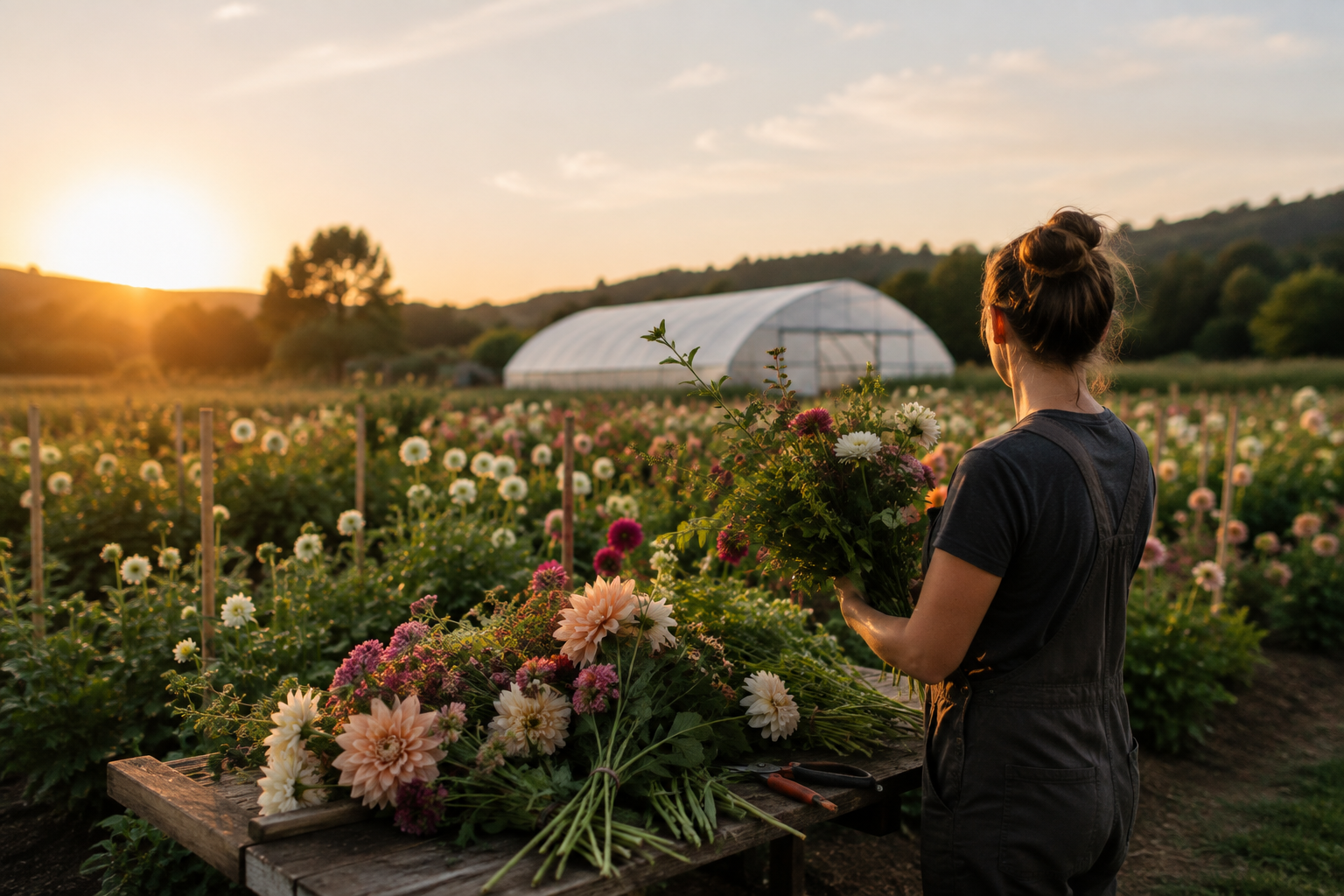
Australia's small flower farms are growing — but for many growers, working out what their flowers are worth remains one of the industry's biggest challenges.
Across regional Australia, small and micro flower farms are carving out a growing place in the market. In Queensland alone, businesses with annual turnover below $200,000 accounted for around half of all nursery and floriculture businesses in the 2025 financial year, according to Australian Bureau of Statistics data reported by ABC.
And for some growers, demand isn't the problem.
Pricing is.
Small-scale growers operate very differently from large commercial flower producers. They often work with smaller volumes, limited infrastructure and higher per-stem production costs.
That can make it difficult to establish a price that reflects the true cost of growing their flowers — particularly when their product is being compared with flowers produced on a much larger scale.
One Queensland grower featured by ABC said it was difficult to value her flowers because small farms simply cannot compete with the infrastructure and resources available to much larger growers.
The issue has prompted The Flower Summit, an Australian industry advocacy group, to develop a national, grower-led flower pricing guide.
The initiative aims to give growers and floral designers a clearer reference point for pricing, with the guide planned for launch in September 2026. The Flower Summit says it has more than 150 members across Australia.
At first glance, pricing might seem like a grower issue.
It isn't.
The price of flowers at the grower and wholesale level ultimately affects what florists pay, how they price their arrangements and how much margin they can retain.
For florists working with locally grown flowers, having a clearer understanding of their value could also make conversations around pricing easier.
A locally grown seasonal flower isn't necessarily competing on the same terms as a mass-produced imported stem.
It may offer:
That creates an opportunity to sell the story as well as the stem.
The question isn't necessarily whether Australian-grown flowers should replace imported flowers.
Australia's flower industry relies on both.
Earlier this year, ABC reported that 60–70% of one Perth wholesaler's flower stock came from overseas, primarily from Ecuador and Kenya. When Middle East conflict disrupted air freight routes, the wholesaler had to increase sourcing from Australian growers and alternative international markets.
The disruption highlighted something florists already know: flower supply can change quickly.
Local growers can provide an important source of seasonal supply, while imports remain important for varieties and volumes that aren't readily available domestically.
For florists, that creates an opportunity to think about local flowers not simply as an alternative, but as a point of difference.
A bouquet described as:
Seasonal flowers, grown locally
tells a very different story from simply listing the varieties inside it.
The growth of small flower farms, combined with efforts to create clearer pricing frameworks, points to a broader conversation taking place across Australian floriculture:
How do we better value locally grown flowers?
That's a question that matters to growers, wholesalers and florists alike.
And as consumers become more interested in where products come from, provenance could become an increasingly useful part of the florist's value proposition.
The industry is still working out exactly what that looks like.
But with a national pricing guide expected later this year, the way Australian-grown flowers are priced — and positioned — is worth watching.
Don't think of local flowers purely in terms of price per stem.
Seasonality, provenance, scarcity and uniqueness can all contribute to the value of an arrangement.
For florists, that could mean an opportunity to differentiate your range — while giving customers another reason to choose something grown closer to home.