
.png)
Return to blogs
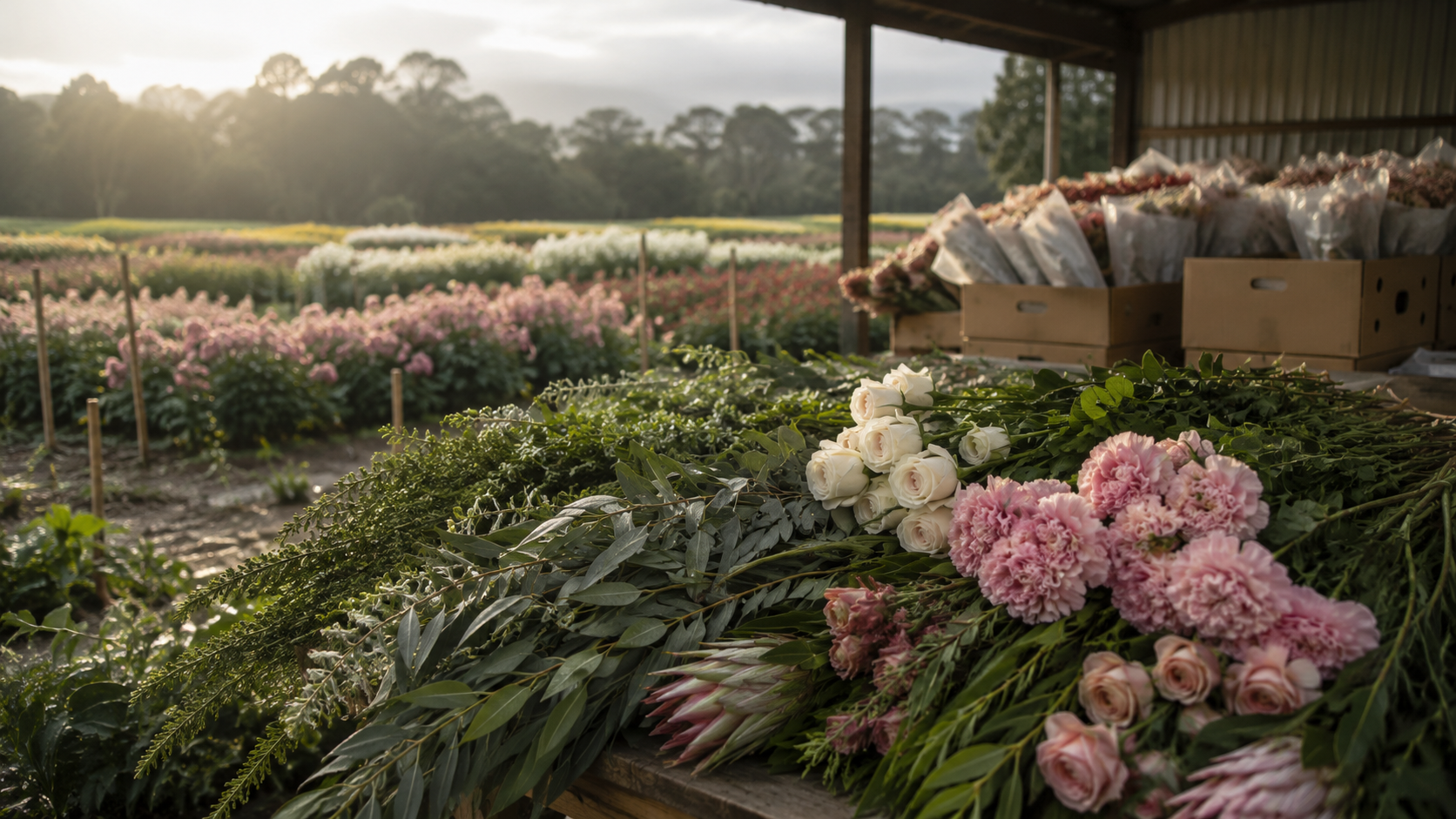
Australia’s flower industry is waiting on a decision that could quietly change the way some imported flowers enter the country.
The Department of Agriculture, Fisheries and Forestry (DAFF) is reviewing Australia’s requirement for devitalisation — a treatment applied to certain imported cut flowers to prevent them from being propagated. The draft review proposes removing that requirement, with a final report expected in the second half of 2026.
For florists, this might sound like a technical biosecurity issue. It isn't entirely.
Australia’s flower market relies on both domestic growers and international supply, so changes to import rules can eventually flow through to what flowers are available, how they are sourced and potentially how suppliers compete on price and range.
Under Australia's current import conditions, some cut flowers that could potentially be propagated from their stems must undergo devitalisation before being released from biosecurity control.
The process effectively prevents the imported material from being used to grow another plant. For some species, this has historically involved dipping stems in a glyphosate solution.
The rule applies to a range of propagatable species, including certain roses, carnations, chrysanthemums, dianthus, hypericum and other flowers and foliage.
But DAFF's review has reached an important conclusion.
Its draft assessment found that the biosecurity risk associated with people attempting to propagate imported cut flowers was negligible to very low for personal use and negligible for commercial use. On that basis, the department concluded that the existing devitalisation requirement was not technically justified and proposed removing it.
The consultation process closed in February this year, and the department is now considering submissions before releasing its final report.
Importantly, the rule has not yet been removed.
Australia has a substantial domestic flower-growing industry, but imported flowers are already an important part of the market.
The latest Australian Horticulture Statistics Handbook puts the value of Australian cut-flower production at $289.9 million in 2023–24. In the same year, Australia imported $96.7 million worth of fresh cut flowers.
The import market is geographically diverse. Major sources in 2023–24 included Malaysia, Kenya, Ecuador, China and Colombia.
That means the Australian flower market isn't simply a choice between "local" and "imported". Florists, wholesalers and growers operate within a supply chain that combines both.
And that's why the proposed change is attracting attention.
Local growers have raised concerns that removing devitalisation could increase biosecurity risks and make imported flowers more competitive.
In December 2025, ABC Rural reported concerns from Australian flower growers about the proposal, including comments from Flower Industry Australia chief executive Anna Jabour. Growers argued that the existing treatment may have acted as a deterrent against propagation and questioned whether the consequences of removing it had been sufficiently tested.
DAFF, meanwhile, says its assessment found the risk from diversion of imported flowers for propagation to be sufficiently low that specific devitalisation measures are not required.
There is therefore a genuine industry tension here.
The debate isn't simply about glyphosate. It's about how Australia balances biosecurity, trade and the competitiveness of domestic flower production.
For most florists, the immediate impact is likely to be limited.
This is not a rule saying imported flowers will suddenly become cheaper, nor does removing devitalisation automatically mean wholesalers will change their product ranges.
But if the proposal becomes policy, there are several things worth watching.
Removing an additional treatment requirement could make the import pathway simpler for affected flowers.
DAFF itself has not assessed whether removing devitalisation would reduce importer costs or processing times, so it would be premature to assume that imported flowers will become cheaper.
However, over time, any reduction in friction within a supply chain has the potential to affect sourcing decisions.
For florists, that could mean greater availability of certain imported varieties or more flexibility from wholesalers.
Australia already has a sizeable imported flower market alongside a $289.9 million domestic production industry.
If import conditions become less restrictive, domestic growers may face a different competitive environment — particularly for varieties that can be sourced reliably from overseas.
For florists, that makes it even more important to understand why you're buying a particular flower from a particular supplier.
Price is one factor. But consistency, vase life, provenance, seasonality, quality and availability all matter when you're building a product range.
There's an interesting counterpoint.
If imported supply becomes easier, locally grown flowers may become more differentiated rather than less.
A florist selling locally grown seasonal flowers isn't necessarily competing with an imported rose purely on price. They're selling provenance, seasonality, freshness and a connection to Australian growers.
That distinction can become commercially useful — particularly when customers are increasingly interested in where products come from.
The opportunity isn't necessarily to argue that imported flowers are bad. It's to make the value of local flowers clear when local provenance genuinely matters to the customer.
For florists, supply diversity is valuable.
Relying too heavily on one grower, wholesaler, variety or country can leave a business exposed when weather, freight, disease, seasonal availability or market conditions change.
A more flexible import environment could eventually give wholesalers and florists another sourcing option.
But the smartest approach isn't necessarily "buy whichever flower is cheapest."
It is understanding which flowers are worth sourcing locally, which are better imported, and which should simply be substituted when availability changes.
Australia's flower industry sits in an unusual position.
Domestic production is significant, but so is international trade. According to DAFF, Australia exported only around $9 million of fresh cut flowers in 2023–24, compared with $96.7 million of imports.
That makes Australia's flower supply chain structurally different from an industry that relies almost entirely on domestic production.
At the same time, Australia maintains strict biosecurity requirements because imported plant material can introduce pests and diseases. DAFF says its revised import conditions introduced in 2018 have contributed to a 70% reduction in detections of quarantine pests in imported fresh cut flowers and foliage.
So the broader question is not whether Australia should have biosecurity protections. It clearly needs them.
The question is which protections are scientifically necessary — and which may be adding cost or complexity without materially reducing risk.
That's ultimately what the current review is trying to answer.
For now, there is nothing florists need to change.
The existing import requirements remain in place, and the final decision has not yet been published. DAFF says the final report is expected in the second half of 2026, although that timeframe is indicative.
The useful thing for florists is simply to keep an eye on what happens next.
If the requirement is removed, watch what happens to wholesale availability, imported varieties, supplier pricing and the positioning of locally grown flowers over the following seasons.
The most interesting effects may not be immediate.
Don't wait for the rules to change before thinking about your supply chain.
Whether flowers are grown 20 kilometres away or arrive from the other side of the world, the strongest florist businesses understand the value of having options — and know exactly why each flower earns its place in the range.