
Return to blogs
Father’s Day arrives this Sunday, 6 September, and Australian retailers are already competing for attention across almost every possible gifting category — from food and alcohol to technology, clothing, grooming, sport and experiences.
For florists, that makes Father’s Day an interesting question.
Not because every dad suddenly needs a bouquet.
But because the traditional idea of what a floral gift looks like may be leaving money on the table.
The latest available Australian Retailers Association and Roy Morgan research provides a useful benchmark.
In 2025, around 4.7 million Australians were expected to spend approximately $720 million on Father’s Day gifts, although participation was down from the previous year as cost-of-living pressures continued to affect discretionary spending.
At the same time, the average planned spend per gift buyer rose to $145, almost 44% higher than in 2024. A quarter of gift buyers planned to spend more than $200.
The message for retailers is fairly clear: Father’s Day shoppers may be fewer, but the customers who do participate are not necessarily looking for the cheapest possible option.
They are looking for something that feels worth buying.
That matters for florists.
The challenge is that Father’s Day has a very different retail culture from Mother’s Day.
Current Australian Father’s Day gift coverage is dominated by practical and interest-based categories: technology, food, cooking, sport, outdoor activities, fashion, grooming and experiences.
That is quite different from Mother’s Day, where flowers remain one of the strongest traditional gifting categories.
The Australian Retail Council's 2026 Mother’s Day research found that 39% of Australians planning to buy a gift intended to purchase flowers, making them the most popular gift category among respondents who knew what they planned to buy.
There is no equivalent evidence suggesting flowers occupy the same position for Father’s Day.
And that distinction is important.
The opportunity isn't necessarily to turn Father's Day into another Mother's Day.
It is to ask whether florists can make flowers fit the occasion on its own terms.
Some florists are already moving in that direction.
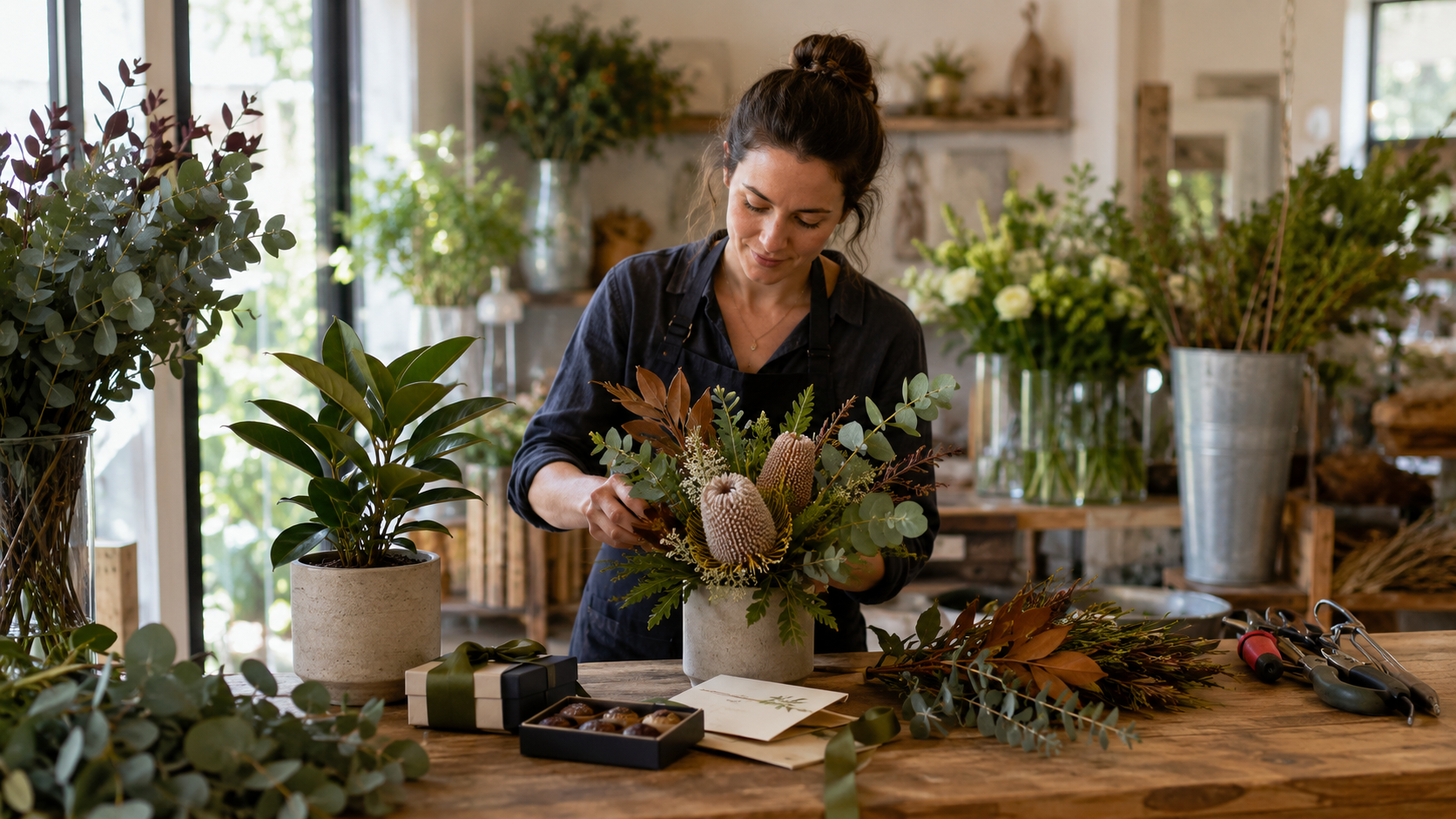
Current Father's Day collections from Australian florists feature native arrangements, textural flowers, indoor plants and floral-and-gift combinations, rather than relying exclusively on conventional pastel bouquets.
That shift makes sense.
A customer shopping for their dad may respond differently to a compact native arrangement, a sculptural plant or a floral gift paired with something connected to his interests than they would to a traditional romantic-style bouquet.
The product doesn't necessarily need to become "masculine".
It needs to become specific.
A plant for the dad who gardens.
A textural native arrangement for someone who prefers Australian-grown flora.
Flowers paired with food or another considered gift.
A restrained arrangement for a home office.
Or simply something designed around the recipient's personality rather than the assumption that every floral gift should look the same.
This is where Father's Day becomes particularly interesting from a business perspective.
The biggest Father's Day spending categories are not necessarily products that florists would traditionally sell. In 2025, the leading categories included food and alcohol, clothing and footwear, grooming, gift cards and technology, while experiences also featured.
That creates a potential role for the florist beyond selling flowers alone.
Instead of asking:
"How do we sell more bouquets for Father's Day?"
the better question may be:
"What would make a Father's Day gift feel complete?"
That could mean a plant and a card.
A native arrangement and a gourmet product.
Flowers alongside chocolates.
A floral gift combined with something from a local producer.
Or a small, well-designed gift set that gives customers a reason to choose the florist rather than another retailer.
Australian florists are already experimenting with this kind of positioning. Current Father's Day collections include combinations involving flowers, plants, chocolates, cocktails and other gifts.
The commercial logic is straightforward: the flower doesn't have to compete with the other gift. It can become part of the gift.
There is another consideration for florists in 2026: Father's Day falls on a Sunday.
That creates a very different fulfilment pattern from a normal weekday gifting occasion.
Some Australian florists are already encouraging customers to order ahead because Sunday delivery availability can be limited or unavailable depending on the florist and delivery network.
For florists, that makes the final days before Father's Day particularly important.
The opportunity isn't just about having a Father's Day collection online.
It is about making the proposition extremely easy to understand:
What can I buy?
Who is it for?
When can it arrive?
What can I add to it?
The closer the customer gets to Sunday, the less patience there is for uncertainty.
Father's Day is a useful test case because it exposes something broader about the modern flower business.
Flowers don't always have to be the entire gift.
They can be the visual centrepiece of a larger gifting occasion.
That distinction becomes particularly valuable as consumers become more selective with discretionary spending. Australia's household spending has remained resilient in 2026, but retailers continue to operate in an environment where customers are weighing value carefully.
For florists, that doesn't necessarily mean discounting.
It may mean making the purchase feel more considered.
A $70 floral gift that feels generic can be difficult to justify against dozens of alternatives.
A $70–$100 gift that feels specifically chosen for the recipient can tell a very different story.
Father's Day probably isn't going to become the next Mother's Day for flowers — and florists don't need it to.
The more interesting opportunity is to stop treating Father's Day as a bouquet occasion and start treating it as a gifting occasion where flowers have a role to play.
That could mean natives, plants, smaller arrangements, gift pairings or products that make the experience feel more personal.
With Father's Day only days away, there isn't much time left to change this year's range.
But the bigger lesson is one worth carrying into next year:
The best seasonal opportunities aren't always about creating more products. Sometimes they're about changing the way customers understand the products you already sell.