
Return to blogs
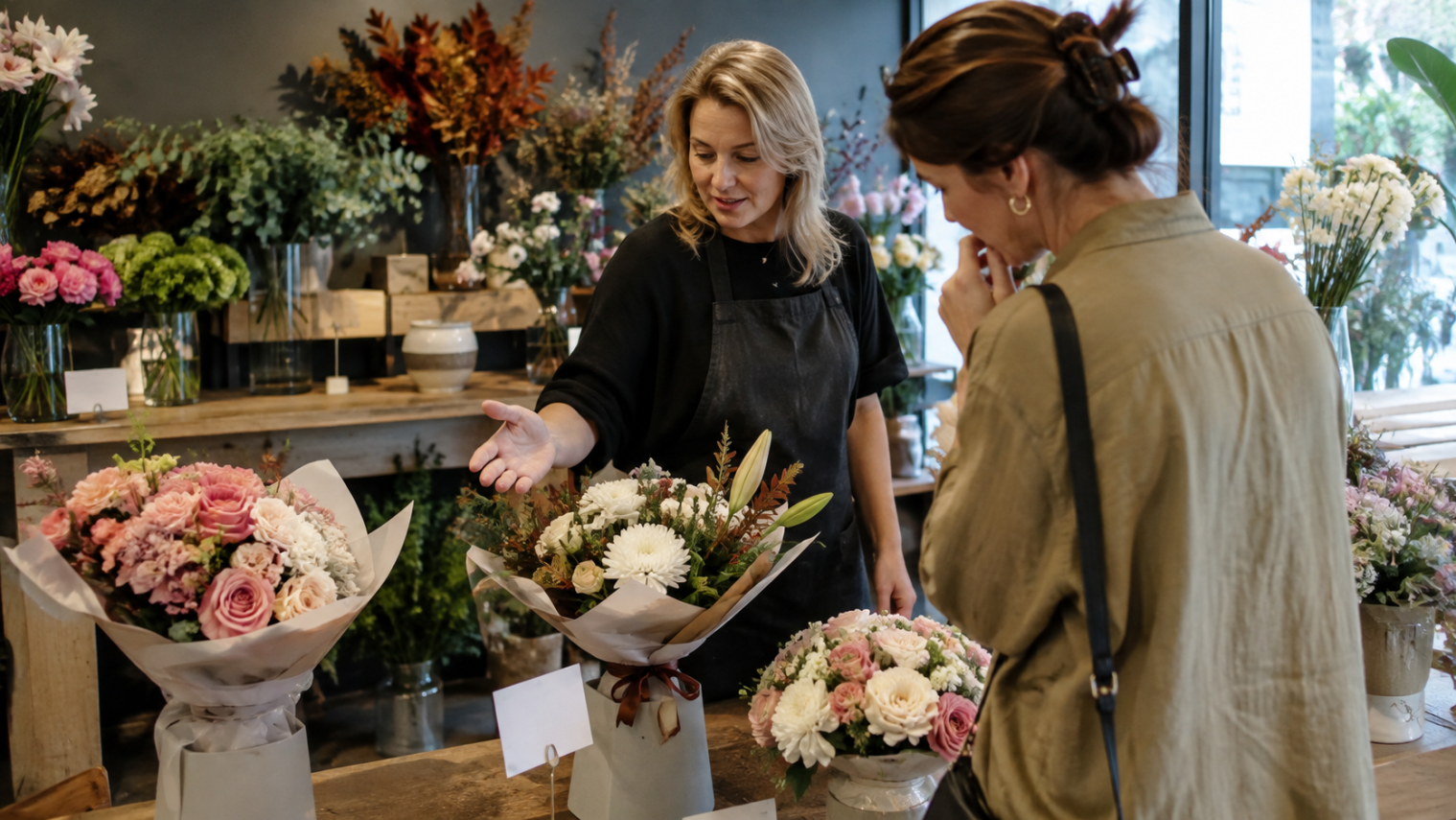
There is a slightly more encouraging signal coming out of the Australian consumer economy this month: people are spending. But the more useful story for florists is what sits underneath that headline. The recovery is not broad-based or carefree. Consumers are still making choices about where their money goes, which means the challenge for a florist is less about creating demand from scratch and more about capturing the demand that is already there.
The Australian Bureau of Statistics reported that household spending rose 0.8% in June 2026, following a 1.2% increase in May. Annual growth reached 6%, while discretionary goods and services spending rose 1.2% in June in seasonally adjusted, current-price terms. The increase was driven by areas including vehicle purchases, air and sea passenger transport, and recreational and cultural services. This is a useful sign that households have not simply stopped spending because of higher living costs.
The picture becomes more complicated when spending is compared with consumer confidence. Westpac's August consumer sentiment index rose 6.0% to 88.9, its second consecutive monthly improvement, after the Reserve Bank held the cash rate at 4.35% on 11 August. Even after that improvement, sentiment remained almost 10% below its level a year earlier. The survey also found that consumers felt more positive about buying major household items, but the measure remained below its long-run average.
For florists, this creates an important distinction: a customer can be willing to spend without being willing to spend indiscriminately. A flower purchase is often discretionary, but it is also emotional and occasion-driven. That makes the category different from a purely functional retail purchase — while still leaving the customer sensitive to perceived value.
One practical response is to make the range of spending options clearer. A customer who has $60 to spend should be able to find an appropriate product without feeling that they are buying the 'cheap' version. A customer who has $150 should likewise understand what additional value they are getting.
This does not mean discounting. In fact, recent results from major Australian retailers show why a blanket low-price strategy can be misleading. Woolworths reported higher FY26 profit alongside sales growth and said cost reduction and increased customer spending contributed to the result, while Wesfarmers reported continued growth at Bunnings and Kmart but also warned that inflation, labour, energy and supply costs remained pressures. The broader retail lesson is that businesses are still trying to give customers a clear value proposition while protecting profitability.
That value proposition can be built around design, freshness, presentation, convenience, delivery, reliability and the confidence that the arrangement will look right when it arrives. A well-designed $90 arrangement does not need to compete with a $60 arrangement purely on the number of stems. It needs to communicate why the extra spend is worthwhile.
This is also a useful moment to examine the gaps in a florist's product range. If the jump from $70 to $120 feels too large, a customer may trade down. If the products at $90, $120 and $150 look almost interchangeable, the customer may trade down because the extra spend is difficult to justify. The question is not simply how many products are in the catalogue, but whether each price point has a clear reason to exist.
The August consumer data does not suggest that Australians have suddenly become carefree spenders. It suggests something more nuanced: households are still spending, but economic confidence remains below normal and spending decisions continue to be selective. For small businesses selling discretionary products, that makes clarity particularly valuable.
The florist opportunity in the current market is not necessarily to sell more expensive flowers or to discount more aggressively. It is to make the value of each purchase easier to understand. Review your key price points, look for awkward gaps, and make sure the difference between a good, better and best option is obvious to the customer. If consumers are becoming more selective rather than simply spending less, the businesses that make the choice easier may be better placed to capture the spending that is already happening.
• Australian Bureau of Statistics — Monthly Household Spending Indicator, June 2026
• Reuters — Australia consumer sentiment brightens in August as rates held
• The Guardian — Woolworths posts $1.14bn profit in cost-of-living crisis
• The Australian — Bunnings, Kmart and AI power Wesfarmers growth in FY26