
Return to blogs
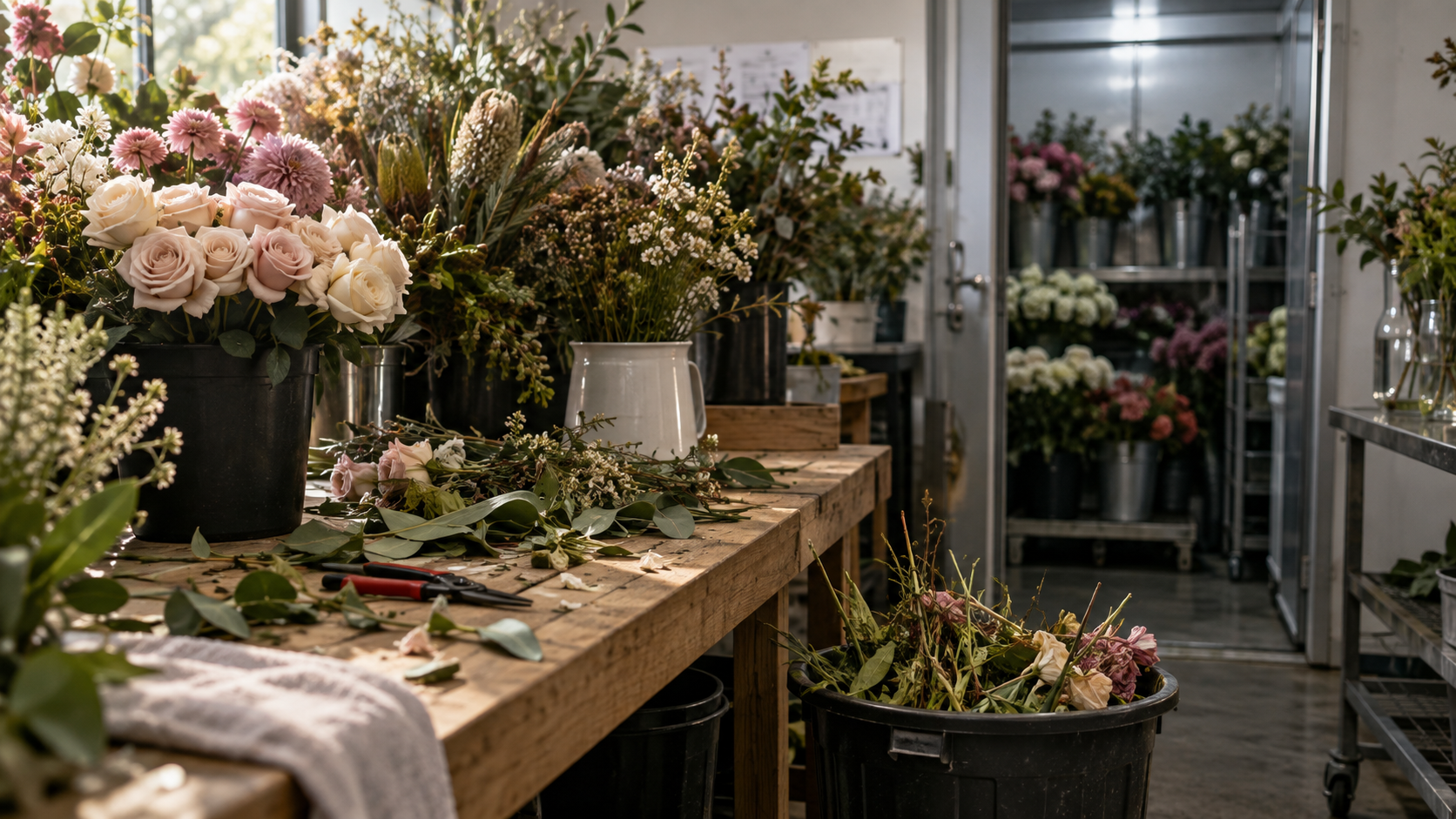
There is a particular kind of business expense that rarely appears neatly on a florist's profit-and-loss statement.
It sits in buckets at the end of the day.
A few stems that didn't sell. Flowers that arrived below standard. A bunch that was forgotten in the back of the coolroom. Foliage trimmed away during production. An arrangement that wasn't collected. A handful of stems that simply reached the end of their useful life.
Individually, none of these seems significant.
Across a month, they can tell a different story.
For florists, waste isn't just a sustainability issue. It's a stock-control issue, a purchasing issue and ultimately a margin issue.
A discarded stem represents more than its wholesale price.
Someone had to grow it, harvest it, grade it, package it, transport it, receive it, condition it and store it. By the time it reaches a florist's bin, money has already been spent several times over.
Australia's cut-flower industry itself is significant: the Department of Agriculture, Fisheries and Forestry puts the value of Australian cut-flower production at $289.9 million in 2023–24, with another $96.7 million of fresh cut flowers imported during the same financial year.
That makes every stem moving through a florist's coolroom part of a much larger perishable supply chain.
And unlike many retail products, flowers don't wait patiently for the next customer.
Their value declines with time.
It's tempting to look for a single percentage that tells florists how much flower waste is "normal".
The reality is more complicated.
Waste can happen because flowers arrive damaged, because a particular variety doesn't sell, because demand was overestimated, because stems deteriorate during storage, or because an arrangement requires more trimming than expected.
The Australian Government's horticulture data demonstrates just how variable loss can be across perishable crops. In 2023–24, average crop loss or waste across Australian horticulture farms was 20%, but varied substantially between different crops. Importantly, this is farm-level horticultural data, not a measurement of florist waste, so it should not be applied directly to retail floristry.
That distinction matters.
There doesn't appear to be a reliable national statistic that says, for example, "Australian florists waste X% of their flowers."
For an individual florist, their own number may therefore be more useful than an industry average.
The easiest place to start isn't buying different flowers or changing suppliers.
It's finding out what's actually being thrown away.
For one month, a florist could record:
The goal isn't to create another complicated administrative task.
It's to identify patterns.
If the same rose variety is repeatedly being discarded, that's different from occasional damage during delivery.
If Monday's leftover stock consistently gets thrown away on Wednesday, that's a stock-rotation problem.
If a particular seasonal flower sells quickly every time it is purchased, buying too little may actually be the problem.
Waste becomes much easier to reduce once it stops being anonymous.
Postharvest handling has a direct impact on how long flowers remain commercially useful.
NSW Agriculture guidance recommends getting stems into clean water quickly, removing unsaleable material, maintaining appropriate storage temperatures and paying close attention to water quality and microbial contamination. For many cut flowers, recommended coolroom temperatures are around 1–4°C, although tropical species require warmer conditions.
That matters commercially because a flower doesn't need to be completely dead to become waste.
It only needs to be below the quality standard a customer expects.
Better conditioning, storage and stock rotation can therefore create value without a florist selling a single additional bouquet.
Postharvest testing can also be surprisingly simple. NC State University's cut-flower research guidance recommends keeping a small, consistent test area where florists can monitor flowers day by day and record when they become unacceptable.
For a florist, that information can eventually answer useful questions:
Which flowers actually hold up best in our conditions?
Which suppliers consistently provide better vase life?
Which varieties need to be sold faster?
Which flowers are worth paying a premium for?
There is another important distinction.
The goal isn't to force every ageing flower into a bouquet just because throwing it away feels wasteful.
That can create a different problem: selling a product that doesn't meet the quality customers expect.
Instead, the better approach is to give ageing stock a planned path before it becomes unusable.
That might mean:
The Sustainable Floristry Network recommends approaches including local and seasonal sourcing, reducing unnecessary packaging and designing in ways that minimise waste.
The important word is planned.
A last-minute attempt to rescue dying stock isn't a stock-management system.
For many florists, the most valuable waste reduction happens before the flowers arrive.
Purchasing based on habit can be expensive.
If a florist automatically orders the same quantities every week regardless of sales, they're effectively accepting a level of waste before the week has even started.
A better system connects purchasing to actual demand.
Look at:
What sold last week?
Not just revenue, but individual varieties and quantities.
What is already booked?
Weddings, corporate orders, subscriptions and regular deliveries create much more predictable demand than walk-in sales.
What's coming up?
Public holidays, local events, weekends and seasonal peaks can materially change requirements.
What's already in the coolroom?
New stock shouldn't automatically take priority over older viable stock.
What has repeatedly become waste?
This is where historical data becomes particularly valuable.
Over time, the florist can move from "I think we'll need about this much" to a much more informed purchasing decision.
The interesting part is that reducing waste doesn't necessarily require a dramatic sustainability program.
It can be as simple as getting better at turning purchased stock into sold stock.
That changes the conversation.
A florist spending more on flowers isn't necessarily becoming less profitable. A florist buying cheaper flowers isn't necessarily improving margin.
The more useful question is:
How much of what I buy actually becomes revenue?
That is the number worth watching.
Flower waste will never reach zero. Perishability is part of the product, and some level of loss is unavoidable.
But unavoidable waste and unmanaged waste are two different things.
The floristry industry is already paying more attention to what happens beyond the finished bouquet.
The Sustainable Floristry Network has made waste, packaging and resource use central parts of its sustainability principles, while research and industry projects continue to investigate how floral materials can be handled more responsibly.
Even new research is looking at the other side of the equation: how to make flowers last longer in the first place. In 2026, researchers at Griffith University reported promising early results from experiments using atmospheric plasma to extend the postharvest life of roses, gerberas and dahlias without relying on conventional chemical treatments.
The technology may be some way from everyday florist use.
The principle isn't.
The longer a quality flower remains sellable, the more value can potentially be extracted from the same piece of stock.
Florists don't need to eliminate waste to improve profitability.
They need to know where it is happening.
Track what gets thrown away. Identify the recurring causes. Look at purchasing, stock rotation, conditioning and demand together.
A bucket of discarded flowers might look like the end of a product's life.
For a business owner, it can also be a useful piece of data.
And sometimes the cheapest margin improvement isn't selling more flowers.
It's getting more value from the flowers you're already buying.