
.png)
Return to blogs
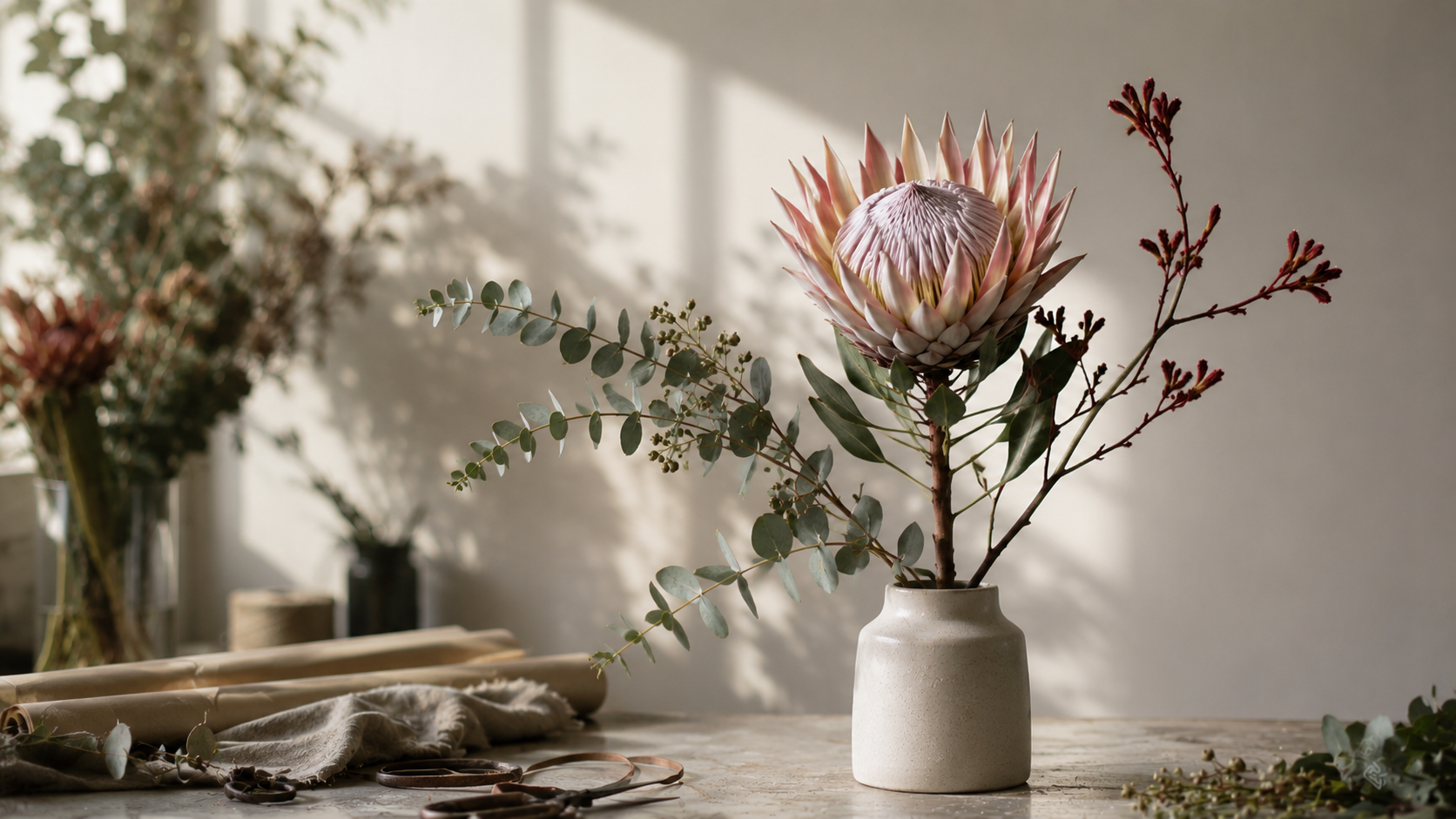
There was a time when the goal of a bouquet was fairly straightforward: combine enough beautiful flowers to create something abundant, balanced and gift-worthy.
In 2026, that formula is being challenged.
Across Australian floristry, there is growing interest in flowers with presence — blooms with unusual shapes, strong silhouettes, distinctive textures or simply enough visual character to command attention on their own.
Dahlias, hydrangeas, kangaroo paw, flowering gums and other native varieties are gaining attention alongside more sculptural flowers such as anthuriums and amaranthus. At the same time, wedding florists are reporting a move towards arrangements where a small number of statement blooms are deliberately given more space.
The result is a different way of thinking about the bouquet.
Instead of asking How many flowers can we fit in?, the question increasingly becomes: Which flower deserves to be noticed?
One of the clearest examples is appearing in wedding work.
Recent Australian wedding coverage describes a shift towards sculptural bouquets, asymmetry, negative space and mono-bloom designs. Rather than hiding individual flowers within a dense arrangement, designers are using fewer, more distinctive blooms and allowing their natural form to become part of the composition.
Melbourne florist reporting in May described a move towards sculptural bridal bouquets featuring just a few statement blooms, including more minimalist interpretations of cascading and teardrop shapes.
It is a subtle change, but an important one.
A large bouquet can create impact through volume. A statement-stem bouquet creates impact through shape, proportion and restraint.
A single anthurium can introduce an architectural line. A trailing amaranthus can create movement. A large dahlia can become a focal point simply because there is enough visual space around it to be noticed.
The flower doesn't need to compete with ten others.
It gets the stage to itself.
There is also evidence that this appetite for distinctive flowers extends beyond wedding styling.
In 2025, ABC reported that dahlias and native wildflowers were increasingly competing with the traditional rose, with Flower Industry Australia pointing to growing consumer interest in Australian-grown flowers and customers looking for more variety.
That pattern continued into 2026.
At Sydney Flower Market ahead of Valentine's Day, growers reported strong demand for dahlias, flowering gums, smoke bush and kangaroo paw, while one rose grower noted that customers were increasingly choosing to mix roses with other flowers rather than buying a traditional rose-only arrangement.
The shift isn't necessarily anti-rose.
It's anti-predictability.
The traditional red rose still has enormous cultural significance, particularly around Valentine's Day. But outside those established occasions, customers appear increasingly willing to experiment with flowers that feel more distinctive.
That gives the statement stem an important advantage: it offers novelty without requiring the customer to abandon flowers altogether.
Part of the appeal is visual.
Flowers such as anthuriums, orchids, amaranthus, dahlias and unusual Australian natives have silhouettes that are immediately recognisable. They can look striking in a photograph before the viewer even knows what the flower is called.
That's particularly useful in a social-media environment where a florist has only a moment to catch someone's attention.
A dense bouquet can be beautiful, but an unusual flower photographed against a simple background can communicate its character instantly.
And social media appears to be influencing what customers ask florists for.
Australian florists have reported customers arriving with images of arrangements they've discovered online and requesting particular looks. Recent coverage has highlighted growing interest in distinctive flowers and designs influenced by high-profile weddings and visual trends.
This creates an interesting feedback loop:
A distinctive flower photographs well → it gets shared → customers discover it → customers ask florists for it → florists source it → more people see it.
The flower itself becomes part of the trend.
There is another factor working in favour of unusual flowers: limited availability.
ABC reported in March that growers were experimenting with unusual native varieties such as Sturt's desert pea in response to growing interest in distinctive Australian blooms. Sydney Flower Market buyers described increased demand for unusual, delicate flowers that had previously been difficult to access.
Importantly, some of these flowers are not available year-round.
That can actually add to their appeal.
A flower that is only available for a short window feels different from one that can be ordered every week of the year. For florists, seasonality becomes part of the story rather than simply a sourcing constraint.
Instead of:
“We don't have that flower today.”
The conversation can become:
“It's only available for a few weeks this season.”
That changes the perceived value.
The customer isn't simply buying a flower. They're buying something temporary, seasonal and harder to replicate.
The statement-stem trend doesn't necessarily mean florists should start selling single flowers in isolation.
The more useful lesson is about how products are designed and presented.
When a particularly beautiful or unusual flower comes into the shop, it doesn't have to disappear into a standard mixed bouquet.
Give it room.
A handful of premium blooms with complementary foliage can sometimes create a stronger visual identity than a larger arrangement containing too many competing varieties.
If a florist receives an unusual shipment of dahlias, native flowers or sculptural stems, the marketing opportunity isn't limited to posting the finished bouquet.
Show the flower itself.
Photograph it close-up. Explain when it is available. Talk about its shape, colour and season. Let customers discover something they may not already know.
That turns flower knowledge into product value.
The downside is that customers inspired by social media may arrive wanting an exact flower that isn't available.
That makes the florist's expertise particularly valuable.
Rather than treating substitution as a compromise, the florist can explain the visual characteristic the customer likes — perhaps a cascading form, unusual texture, strong colour or sculptural silhouette — and recommend a seasonal alternative that achieves a similar effect.
The customer may not actually need that exact flower.
They need that feeling.
The statement stem is part of a broader movement towards flowers that feel more intentional.
Current Australian wedding trends are pointing towards asymmetry, mono-bloom arrangements, sculptural forms and stronger colour choices, while local flower-market reporting shows customers becoming more interested in distinctive seasonal and Australian-grown varieties.
Together, these signals suggest that consumers are becoming more visually literate about flowers.
They are not simply asking for “something pretty”.
They are noticing form.
They recognise the difference between a dahlia and a rose. They save images of unusual arrangements. They ask where flowers were grown. They notice colour, shape and texture.
For florists, that's an opportunity.
The more customers learn about flowers, the more important the florist's role becomes in helping them discover something new.
The statement stem isn't really about selling fewer flowers.
It's about making individual flowers matter more.
A distinctive bloom can create the focal point of an arrangement, give a seasonal bouquet its personality or provide the visual hook that makes someone stop scrolling.
And as consumers become more curious about unusual varieties, local flowers and expressive floral design, the florist's ability to recognise a great stem — and know exactly how to make it shine — becomes a valuable part of the product.
In 2026, sometimes the most memorable bouquet might not be the one with the most flowers.
It might be the one with one flower you can't stop looking at.