
Return to blogs
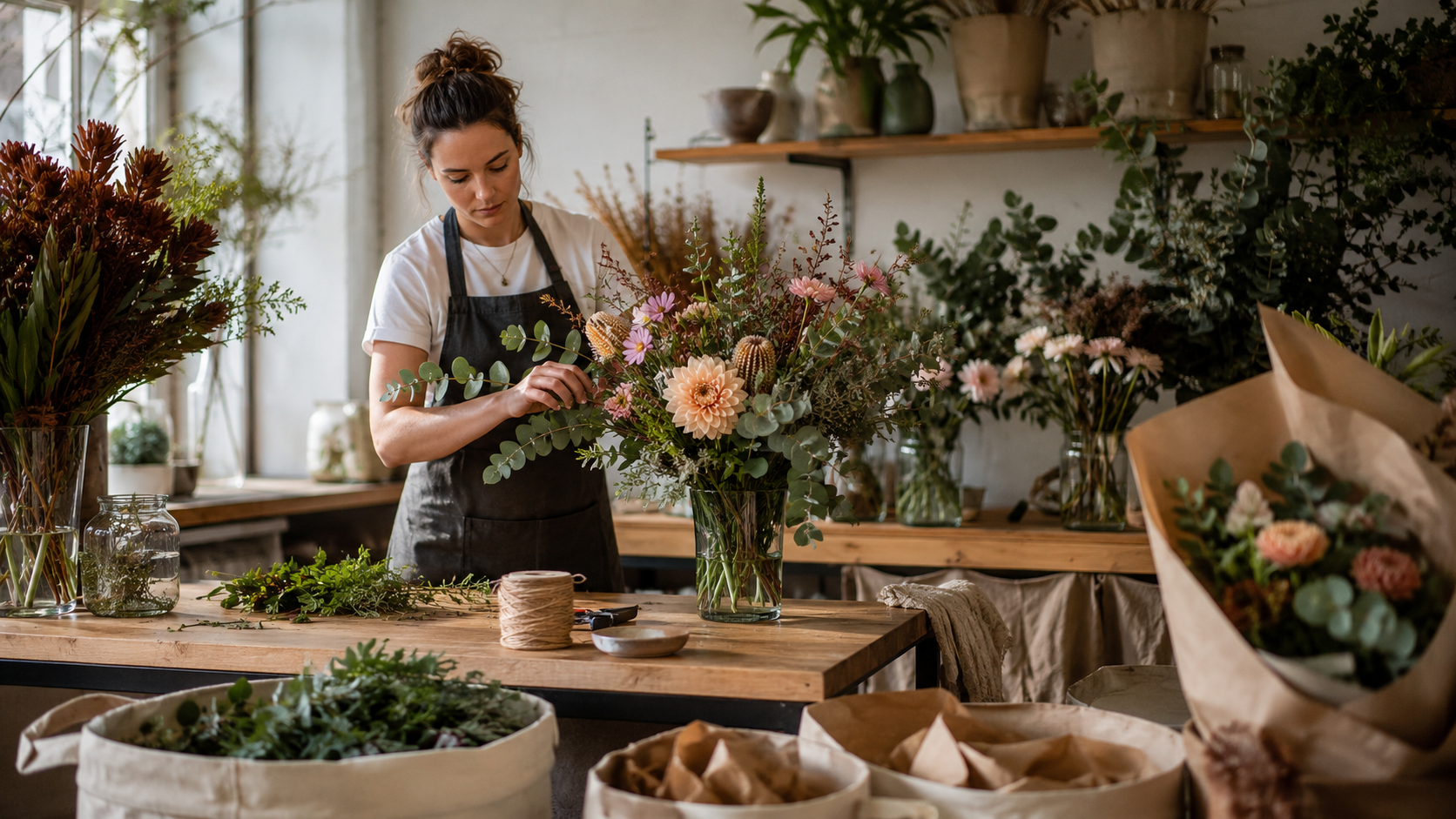
Floristry has an obvious environmental paradox.
It is an industry built around flowers, plants and the natural world — yet some of the materials and systems traditionally used to sell and display those flowers are anything but natural.
Floral foam, single-use plastic sleeves, imported flowers, disposable packaging and green waste all sit somewhere within the modern florist's supply chain. And while individual businesses have been making changes for years, sustainability has often remained something a florist chooses to prioritise rather than something the broader industry expects.
That may not remain the case forever.
The sustainability conversation is becoming more sophisticated, and Australian florists are already experimenting with different ways of sourcing, designing, packaging and disposing of flowers. The question now is whether those practices move from the edges of the industry towards the mainstream.
Few products illustrate the sustainability challenge in floristry better than floral foam.
Traditional floral foam is a single-use plastic material. The Sustainable Floristry Network notes that it can crumble into tiny particles during use and that foam fragments can end up in vase water, soil and waterways. It also warns that floral foam should not be placed in compost or garden waste.
For decades, however, foam has been extraordinarily useful. It is quick, inexpensive and gives florists a level of control that alternative mechanics don't always replicate.
That is why replacing it isn't as simple as saying stop using floral foam.
There are technical, commercial and creative considerations involved — particularly for large installations, events and arrangements where mechanics need to hold substantial quantities of flowers securely.
But alternatives are becoming increasingly visible.
Australian florists are using reusable mechanics, vessels, chicken wire and other techniques to create foam-free designs. Meanwhile, new products are also entering the market. In June 2026, Koch & Co began promoting OASIS Renewal, a plant-based floral foam positioned as a lower-impact alternative to conventional petroleum-based foam, while acknowledging that testing around biodegradability and compostability remains ongoing.
That distinction matters.
"Plant-based" does not automatically mean "compostable", and "more sustainable" does not necessarily mean "sustainable".
Florists will increasingly need to look beyond the marketing language attached to products and understand what actually happens to them at the end of their useful life.
Floral packaging presents a similar problem.
A bouquet may look beautifully considered from the customer's perspective, but behind it can be layers of sleeves, wraps, wet packaging, ribbons, plastic bags and other materials designed to protect the product during transport.
Australia is already trying to move towards a more circular packaging system. The Australian Packaging Covenant Organisation's latest data shows that 86% of packaging was reusable, recyclable or compostable in 2023–24, while the plastic packaging recovery rate was only 20%. The amount of problematic and unnecessary single-use plastic packaging had fallen 46% from the 2017–18 baseline.
The picture is therefore mixed: progress is happening, but the system is far from solved.
The Australian Government's packaging framework also places increasing emphasis on businesses designing packaging that creates less environmental impact and can be more effectively recycled.
For an individual florist, that doesn't necessarily mean a new regulatory burden is about to arrive at the shop door.
It does mean the broader direction of travel is clear.
Packaging is increasingly being viewed through questions of reuse, recyclability, material choice and end-of-life, rather than simply whether something looks good or protects the flowers.
Perhaps the most interesting part of the sustainability conversation is that there is no single model emerging.
Some florists are reducing plastic. Others are eliminating floral foam. Some are prioritising Australian-grown and seasonal flowers. Others are introducing reusable vessels or finding ways to divert more waste from landfill.
Melbourne florist Thrive Flowers, for example, says it has eliminated floral foam and separates its studio waste into multiple streams, including organics, soft plastics, flower sleeves, cardboard and e-waste. It reports diverting 90% of its waste from landfill.
Other Australian florists are experimenting with vase-return systems, reusable vessels and locally sourced flowers.
These businesses aren't necessarily following exactly the same philosophy.
That's important because sustainability in floristry isn't likely to become a single checklist that every florist follows in exactly the same way.
Instead, businesses are beginning to make different decisions about where they can have the greatest impact.
The temptation is to think sustainability means spending more money on environmentally friendly products.
Sometimes it does.
But it can also mean buying less, reusing more and creating less waste in the first place.
A florist could look at:
The commercial question is just as important as the environmental one.
A reusable vase program, for example, could potentially create a repeat interaction with a customer. Better waste separation may reduce unnecessary landfill disposal. Seasonal purchasing can create a different product mix. And more thoughtful packaging can potentially reduce material costs as well as waste.
None of these outcomes is guaranteed.
But it demonstrates why sustainability shouldn't automatically be treated as a cost centre.
There is another reason this conversation is unlikely to disappear: customers are becoming more interested in what sits behind the product they buy.
Australian florists are already reporting customers asking about locally grown flowers and the environmental impact of their purchases.
That doesn't mean every flower customer is going to interrogate a florist about carbon emissions before ordering a birthday bouquet.
But expectations can change gradually.
A customer may notice that one florist offers locally grown seasonal flowers. Another may offer vase returns. Another may explain why it doesn't use floral foam.
Over time, these details become part of how a business is perceived.
That creates an opportunity — but also a warning.
Florists shouldn't make sustainability claims simply because they sound good.
If a business says its packaging is recyclable, compostable, locally sourced or environmentally friendly, it needs to understand what that actually means.
Sustainability is becoming less about saying the right thing and more about being able to explain what you actually do.
The Australian packaging system itself demonstrates that this transition will not happen overnight.
APCO says Australia's original 2025 National Packaging Targets were not fully achieved and that work is continuing towards a revised target date.
Floristry also has unique challenges that make the transition more complicated than simply replacing one material with another.
Flowers are perishable. They need water. They need protection during transport. Weddings and events can require large temporary installations. Customers expect presentation to be part of the product.
The industry's sustainability challenge is therefore not about making flowers look less beautiful.
It is about finding better ways to source, design, package, deliver and ultimately dispose of them without creating unnecessary waste along the way.
And that is why this is worth watching.
The most interesting change may not be one dramatic new product or regulation.
It may be the gradual disappearance of practices that have simply been accepted as normal.
Florists don't need to become perfectly sustainable businesses overnight.
But they should start asking a more useful question:
If we were designing our business from scratch today, would we still do things the way the industry has always done them?
For some florists, the answer will be yes.
For others, it might mean less foam, less plastic, more reuse, more seasonal product, better waste separation or simply a closer look at what happens to materials once an order leaves the shop.
The opportunity is to make those changes deliberately — before customers, suppliers or regulation make the decision for you.