
Return to blogs
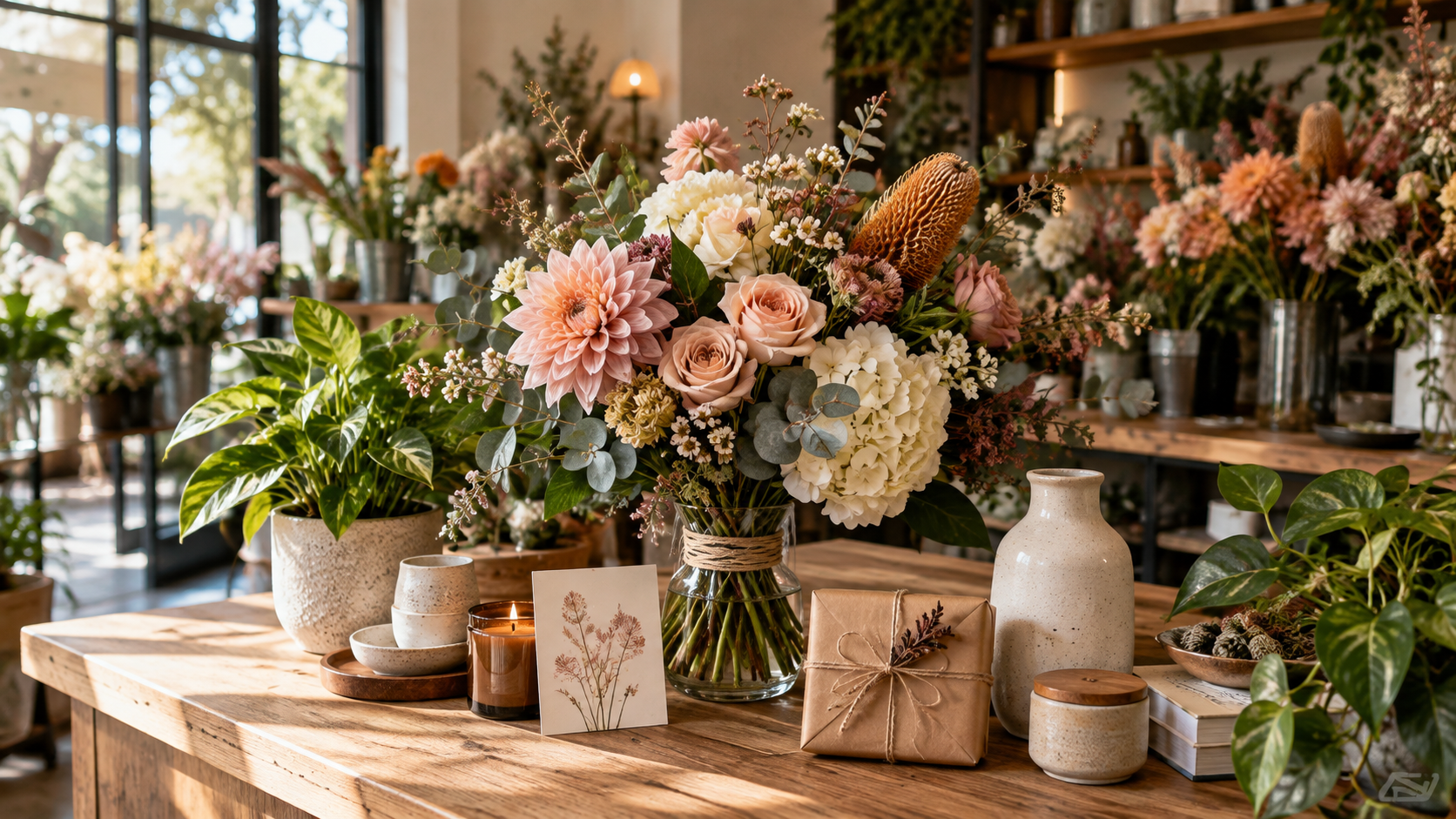
A florist doesn't necessarily need more customers to grow.
Sometimes, the opportunity is already standing in front of the counter.
A customer comes in looking for flowers and leaves with a bouquet. But what if they also found a beautiful candle, a locally made piece of homeware, a plant, a card or another small gift that completed the occasion?
The idea isn't new. Florists have long sold products alongside flowers. What is changing is the broader retail environment — and the opportunity to think more deliberately about what belongs in a florist's product mix.
Australia's retail trade-fair sector is increasingly built around exactly this question. The 2026 AGHA Gift Fairs bring together categories including giftware, homewares, lifestyle, fashion, jewellery, wellness, food, outdoor and garden products, and stationery. The upcoming Sydney Gift Fair runs from 19–21 September and is explicitly positioned as a sourcing event for retailers looking for new products and emerging brands.
For florists, the question isn't whether they can sell more products.
It's which products make sense alongside flowers?
The biggest advantage a florist has isn't refrigeration, a shopfront or even flowers.
It's the reason the customer is buying.
Someone ordering flowers is usually trying to communicate something: congratulations, sympathy, love, gratitude, celebration or simply "I'm thinking of you."
That makes a florist fundamentally different from a conventional gift shop.
A customer doesn't necessarily want to browse hundreds of unrelated products. They want to find something appropriate for a person and an occasion — ideally without having to visit three different stores.
That creates a natural opportunity to build around the bouquet rather than move away from it.
The temptation with diversification is to keep adding products until the florist starts looking like a general gift store.
That's probably the wrong approach.
The better question is:
Does this product make the flower purchase better, easier or more complete?
A few categories naturally pass that test.
Plants are perhaps the most obvious extension.
They occupy the same broad emotional territory as flowers while offering a different proposition: longevity.
Industry commentary has previously highlighted potted plants as an additional revenue category for florists because they can be sold as gifts, require less intensive handling than fresh flowers and don't necessarily need refrigeration.
The opportunity isn't necessarily to compete with a nursery on plant selection.
It is to make the plant giftable.
A well-presented orchid, indoor plant or small botanical arrangement can become a florist product rather than simply a plant sitting in a pot.
Candles, vases, ceramics and other small homewares can make sense for a similar reason.
They connect naturally to the home, interiors and gifting — areas that already overlap with flowers.
The Australian Gift & Homewares Association's 2026 retail events reflect just how broad this adjacent market has become, with homewares, lifestyle products, décor and artisan-made goods all sitting within the same retail ecosystem.
The important word is small.
A florist doesn't need to become a furniture store.
A handful of well-selected products can be more effective than shelves packed with unrelated stock.
There is another particularly interesting opportunity for independent florists: local products with a strong story.
AGHA's Australian Made Pavilion has brought together Australian manufacturers across categories including lifestyle, beauty, pet, home and gifting. The organisation says the 2026 Melbourne event featured more than 30 Australian Made businesses.
For a florist, this can create a retail proposition that feels more curated than mass-market.
A locally made candle beside a seasonal Australian bouquet tells a more coherent story than simply adding another generic gift product.
The simplest products can sometimes be the most logical.
Greeting cards, small keepsakes and other inexpensive additions can solve a very specific customer problem: "I need to send a gift, and I want to say something with it."
The objective isn't necessarily to generate a huge amount of revenue from every individual add-on.
It's to make the florist a more complete destination for the occasion.
More products don't automatically mean more sales.
They can also mean more inventory, more capital tied up in stock, more suppliers, more merchandising and more products that eventually need discounting.
That's why diversification needs to be treated as a retail strategy, not a shopping spree.
A useful test for any potential new product is:
Does it fit the occasions my customers already buy for?
Can I merchandise it naturally alongside flowers?
Can I deliver it without creating operational headaches?
Does it have enough margin to justify the space and handling?
Does it feel distinctive enough that customers couldn't simply buy it anywhere?
If the answer to most of those questions is no, it probably doesn't belong.
One advantage florists have over many retailers is that their businesses are already highly seasonal.
That creates an opportunity to keep the broader range moving rather than permanently carrying dozens of categories.
A spring collection could lean into gardening, ceramics and botanical gifts.
Christmas could bring in locally made food, candles and small homewares.
Mother's Day could combine flowers with plants, self-care products and keepsakes.
The product doesn't have to remain on the shelf all year.
In fact, limited seasonal ranges may be more compelling than a permanently expanded catalogue.
Plants are particularly interesting because they're not simply another gift category.
The broader Australian horticultural market is also adapting to changing consumer behaviour and retail channels. At the 2026 AIPH Industry Conference in Sydney, Greenlife Industry Australia discussed how plant demand remains above pre-COVID levels but has become less consistent and predictable, with retail channels continuing to evolve.
For florists, that reinforces an important point: adding a category doesn't remove the need for good buying.
A new product still needs the right price, presentation, stock level and customer proposition.
It is becoming a better gifting destination.
Flowers should probably remain at the centre.
But the customer doesn't necessarily think in categories.
They think:
"I need something beautiful for Mum."
"I want to send something to someone who's just moved house."
"I need a gift for a friend."
"I want to say thank you."
The florist that can solve that problem with flowers — and a small, carefully curated selection of things that complement them — may have a stronger proposition than one that simply offers a larger bouquet catalogue.
And there is evidence that Australians continue to value flowers precisely within this gifting context. In 2026, flowers were again the most popular planned Mother's Day gift among Australians who knew what they intended to buy, with 39% selecting flowers.
The opportunity, then, isn't to move beyond flowers.
It's to build around them.
Before adding another product category, ask one simple question:
Does this help my customer give a better gift?
If it does, it might deserve a place in the shop.
If it doesn't, it is probably just more stock.
For florists looking at their next buying cycle, that distinction could be more valuable than another ten products on the shelf.